Philippians
PDF Notes
PDF Slides
(click to view, right-click to download)
God has given his people each other as one of the sweetest graces. Being part of the family of God and engaging in ministry with our brothers and sisters in Christ is meant to be a delight. In the letter to the Philippians, Paul, while stowed away in a prison cell, writes this joy–filled letter to a church that had partnered with him in the gospel from the very beginning.
- Friendly and affectionate
- More commendation than correction
- Personal - Paul shares his testimony
Background - the City of Philippi
- Ancient city, named after King Philip of Macedon, father of Alexander the Great
- Taken by the Romans c. 168 B.C.
- Was one of the chief cities of the district, with a notable history
Situation
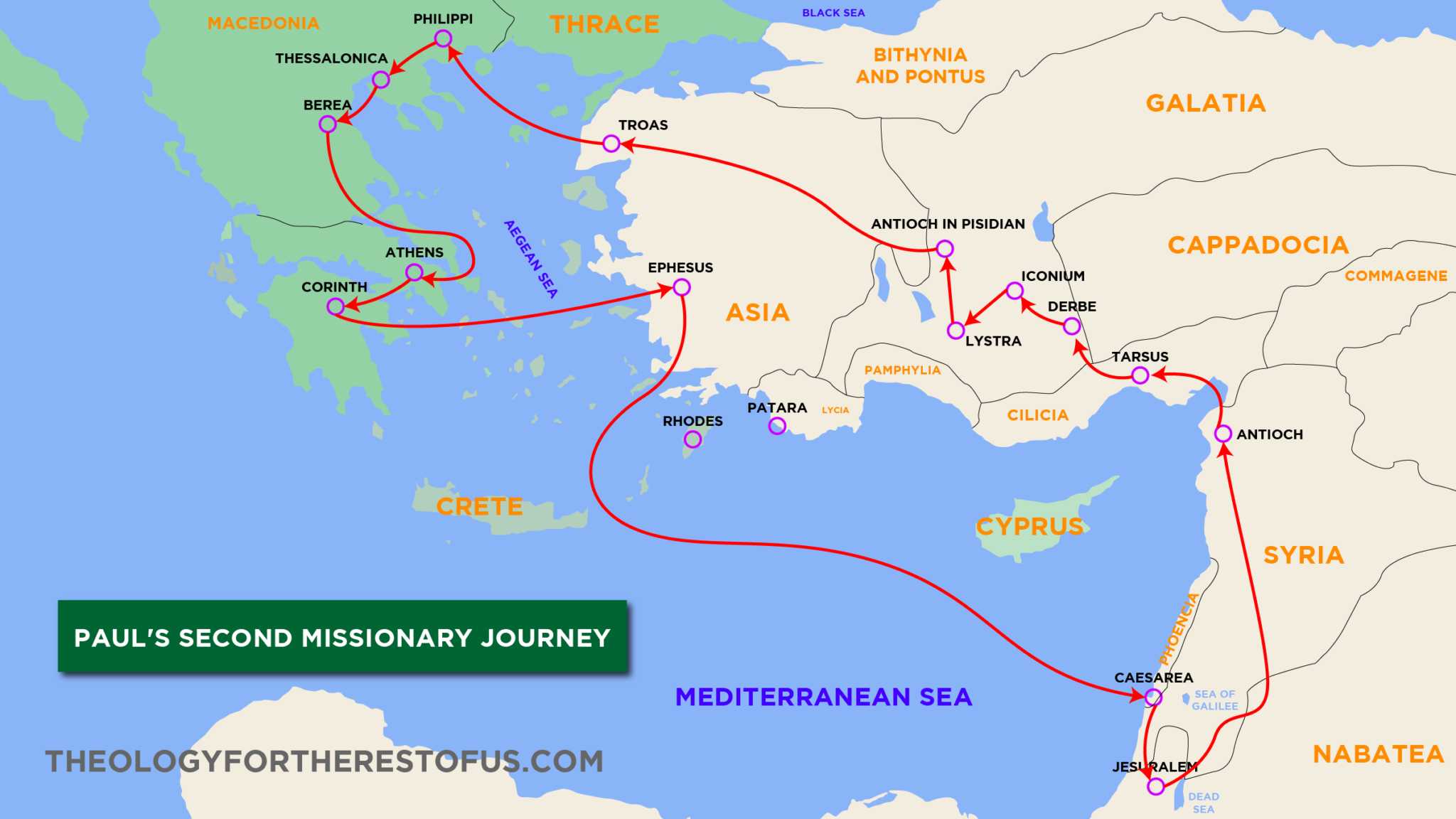
- Paul first came to Philippi on his second missionary journey (Acts 16.6-40 NASB95), c. AD 52.
- As as a direct result of The “Macedonian Call” - this was the first place to which he came
- Salvation of Lydia and her household
- Salvation of the Philippian jailer
Author and Audience and Date
- Paul writes the letter from prison, and includes Timothy who is with him
- “But I hope in the Lord Jesus to send Timothy to you shortly” (2:19)
- probably written about the same time as Ephesians, while under house arrest in Rome, c. AD 62
- The Church at Philippi was made up of people from very different walks of life.
- A merchant woman named Lydia (Acts 16:14 NASB95)
- a recently demon–possessed slave girl (Acts 16:16–18 NASB95)
- a jailer (Acts 16:25–35 NASB95)
These were all converts from Paul’s first trip to Philippi. If this is any indication of what the membership roll looked like, then we can understand Paul’s appeal to unity of mind in the Philippian letter!
Yet, this diverse congregation had supported Paul from the beginning and was dear to Paul’s heart (1:8). God had taken very different people from the city of Philippi and brought them together to advance the gospel.
Paul makes a point of commending Timothy and Epaphroditus
Outline
- Greeting, thanksgiving and prayer (1.1-11)
- Paul’s purpose and joy (1.12-26)
- Exhortation and example (1.27-2.18)
- Paul’s future plans (2.19-30)
- Warning and personal testimony (3.1-21)
- Encouragement, gratitude and greeting (4.1-23)
Themes
The Gospel
Partnership, Perseverance, Persecution
I thank my God in all my remembrance of you, always offering prayer with joy in my every prayer for you all, in view of your participation in the gospel from the first day until now. (1:3-5)
For it is only right for me to feel this way about you all, because I have you in my heart, since both in my imprisonment and in the defense and confirmation of the gospel, you all are partakers of grace with me. (1:7)
Now I want you to know, brethren, that my circumstances have turned out for the greater progress of the gospel… (1:12)
Working it Out
For I am confident of this very thing, that He who began a good work in you will perfect it until the day of Christ Jesus. (1:6)
work out your salvation with fear and trembling; for it is God who is at work in you, both to will and to work for His good pleasure. (2:12-13)
Joy and Peace
What then? Only that in every way, whether in pretense or in truth, Christ is proclaimed; and in this I rejoice. Yes, and I will rejoice… (1:18)
But even if I am being poured out as a drink offering upon the sacrifice and service of your faith, I rejoice and share my joy with you all. You too, I urge you, rejoice in the same way and share your joy with me. (2:17-18)
Rejoice in the Lord always; again I will say, rejoice! Let your gentle spirit be known to all men. The Lord is near. Be anxious for nothing, but in everything by prayer and supplication with thanksgiving let your requests be made known to God. And the peace of God, which surpasses all comprehension, will guard your hearts and your minds in Christ Jesus. (4:4-7)
- Paul has joy because the Gospel is being preached, regardless of this own circumstances
- The words “joy” and “rejoice” occur 15 times in this letter.
- Anxiety and Gratitude cannot co-exist in our brains!
Highlights
Hymn of Kenosis - 2.6-11
KENOSIS
κενόω - empty, evacuate; to divest one’s self of one’s prerogatives, abase one’s self, give up or lay aside what one possesses.
Jesus —
- Did not cling to divine privilege or status
- Took on full human nature, accepting human limitations
- Lived in dependence upon the Father, in humility and obedience
- Submitted to suffering and death.
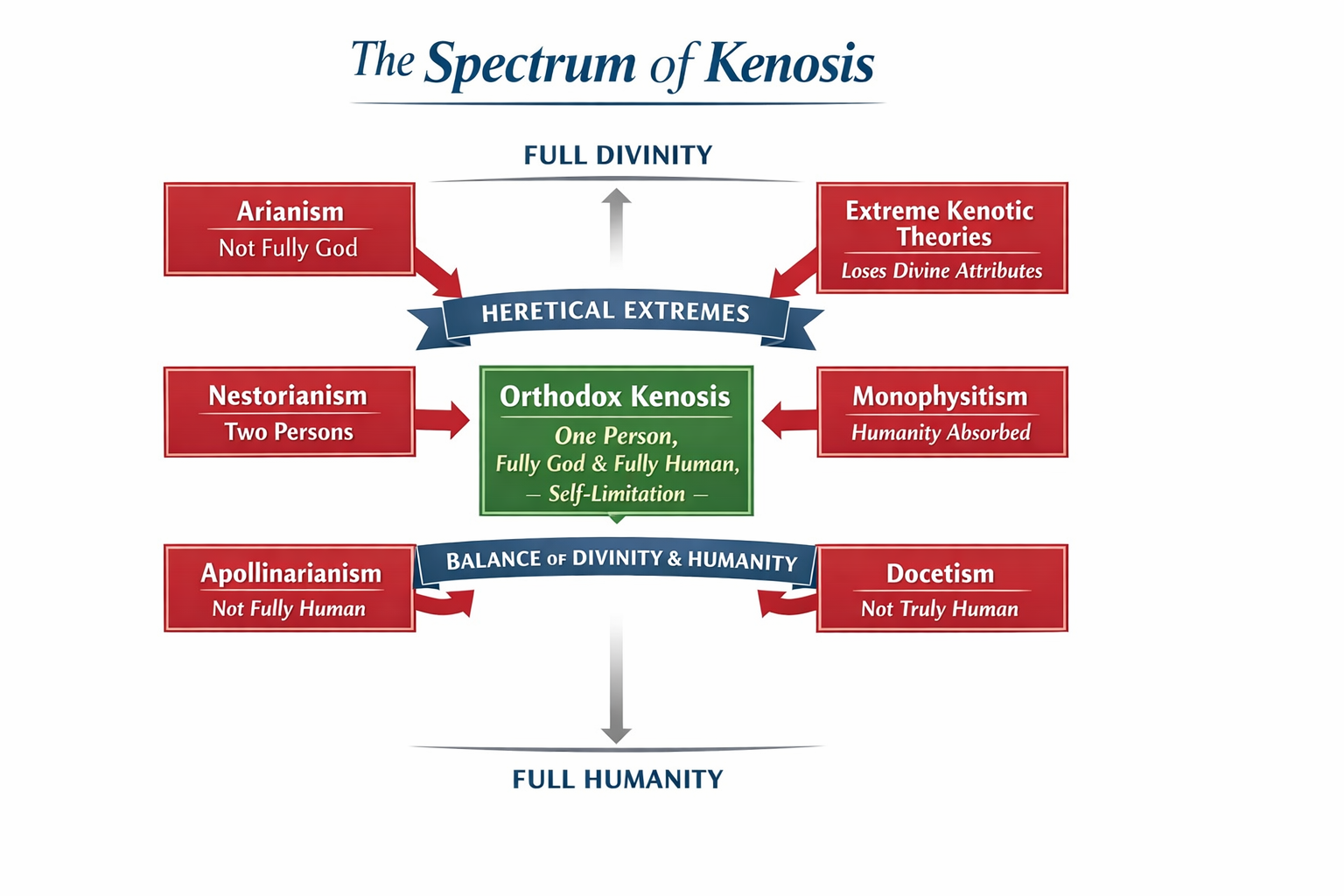
KENOSIS is Self-humbling and voluntary limitation, not loss of divinity
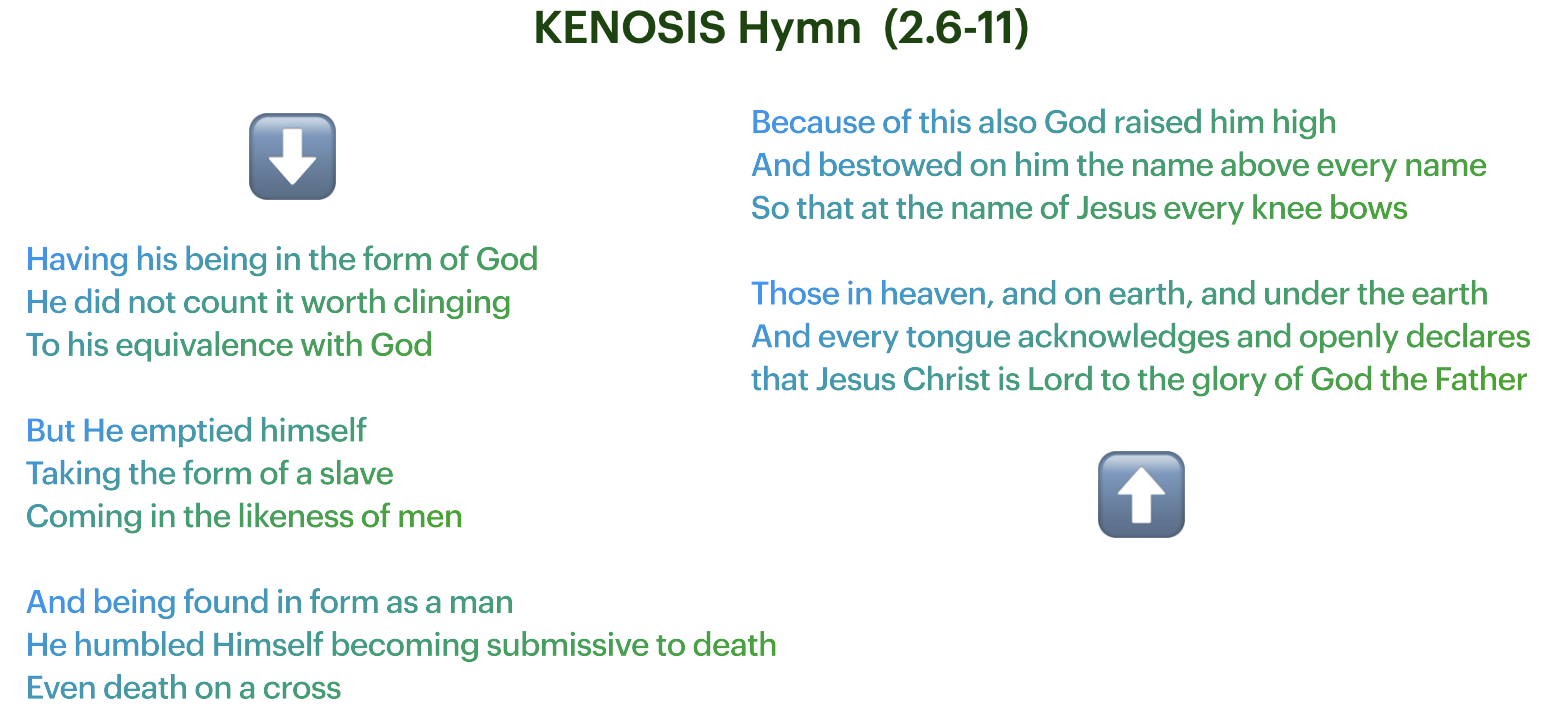
- He went to the lowest place. God raised Him to the highest place.
- We follow His example: “Have this attitude in yourselves which was also in Christ Jesus” (2:5)
Misunderstandings of KENOSIS lead to Christological heresies
- Arianism — Christ is not Eternal God; “there was a time when Christ was not”
- Apollinarianism — Christ had a human body but a divine mind; intended to protect Christ’s divinity
- Nestorianism — Christ is divided into two persons, one human, one divine
| Heretical View | KENOSIS Misunderstood | Biblical Answer |
|---|---|---|
| Arianism | God cannot “empty” Himself. Christ is a man, the first creation of God | Christ is fully divine and fully human; The Incarnation is God emptying Himself of His rights, not His nature |
| Apollinarianism | Christ is God with a human body and God’s mind, not a human mind | Christ has a full human nature like ours, together with His nature as God |
| Nestorianism | Christ is two persons, one human and one divine. Only the human person “empties” himself | Christ is not divided. He is one person with two natures: human and divine |
Why this matters
Jesus must be a man like us, in order to redeem us.
“Therefore, since the children share in flesh and blood, He Himself likewise also partook of the same, that through death He might render powerless him who had the power of death, that is, the devil, and might free those who through fear of death were subject to slavery all their lives…He had to be made like His brethren in all things, so that He might become a merciful and faithful high priest in things pertaining to God, to make propitiation for the sins of the people.” (Heb. 2:14-17)
“He gave Him authority to execute judgment, because He is the Son of Man.” (John 5:27)
“unless you believe that I AM, you will die in your sins.” (John 8:24)
Paul’s Testimony
- Past Performance: Impeccable credentials (Philippians 3.3-6 NASB95)
- Present Posture: All that is worthless. Christ is everything (Philippians 3.7-11 NASB95)
- Future Focus - Pressing on for the prize! (Philippians 3.12-14 NASB95)
Assignment
Preparing
- Read Acts 16.6-40, Philippians
- Read chapter 14 of Introducing the New Testament (Philippians)
- Watch The Bible Project Philippians below
Respond to the following:
Knowing
- Who is with Paul when he wrote this letter?
- Give a definition of “kenosis”
Reflecting
- Paul is sitting in prison as he writes this letter. What accounts for his pervading joy in his circumstances?
- Why is a right understanding of kenosis important?
- What passage in Philippians is particularly encouraging to you, and why?
Communicating
Someone is discouraged, disturbed and depressed (maybe it’s you!). Take the Word of God, specifically Philippians 4.4-7 NASB95, to speak help, hope and blessing to this person.
Leave a Comment
