Colossians and Philemon
PDF Notes
PDF Slides
(click to view, right-click to download)
Background - the City of Colossae
- Colossae was a small and insignificant town in Asia Minor, about 120 miles east of Ephesus on the Lycus river valley
- it was close to Laodicea, one of the 7 churches of Revelation
When this letter is read among you, have it also read in the church of the Laodiceans; and you, for your part read my letter that is coming from Laodicea. (4:16)
- It was a city plagued by earthquakes and was ethnically diverse.
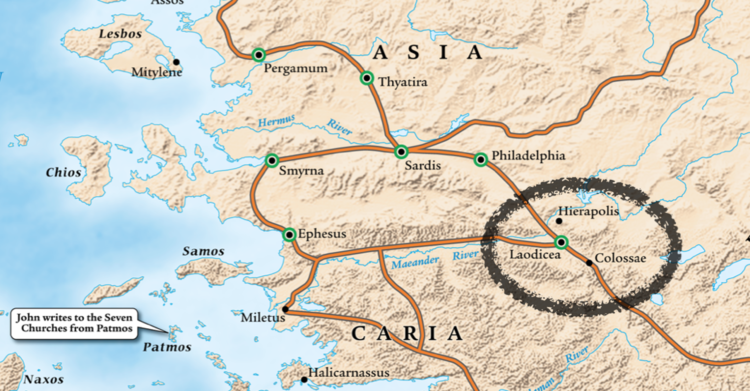
Situation
- The gospel came to Colossae during Paul’s extended stay in Ephesus, through Epaphras who was a Colossian, c. AD 55
- Epaphras is named by Paul in both letters
- Paul had not visited this church when he wrote these letters, and maybe never did
- it was a bit of a hike from Ephesus to Colossae, about 120 miles
- Typical travel time: 6–10 days on foot
The proto-gnostic heresy
Epaphras (1.7, 4.2) the Colossian who had brought the gospel to Colossae, had reported to Paul that his beloved home church was falling prey to dangerous error in the form of Gnostic false teaching.
The term “Gnostic” comes from the Greek word “gnosis” which means knowledge.
Gnosticism has many manifestations, but the common element in all of them is a setting forth of requirements by which we attain to salvation only through some kind of “special knowledge.”
- performance of secret rites
- observance of external ordinances like keeping of feast days
- ascetic practices like fasts, self-abasement, and abstinence
- pursuit of heaven through a hierarchy of angelic mediaries
Author and Audience and Date
- Paul writes these letters from prison, and includes Timothy who is with him, like Philippians
- Colossians is written to the church, Philemon is written to an individual member of the church in Colossae
- written around the same time as Ephesians and Philippians, while under house arrest in Rome, c. AD 61
- Philemon is written to Philemon, and “Apphia our sister and Archippus our fellow soldier, and the church in your house” (vs. 2).
- these all lived in Colossae (cf. Col. 4:9 NASB95).
Colossians Outline
- Greeting, thanksgiving, and prayer (Col. 1.1-14 NASB95)
- Supremacy and Suffering of Christ (Col. 1.5-2.23 NASB95)
- Life in Christ (Col. 3.1-4.6 NASB95)
- Letter delivery, instructions, final greeting (Col. 4.7-18 NASB95)
Philemon Outline
- Greeting and thanksgiving (Phm 1.1 NASB95)
- Plea and request for Onesimus (Phm 1.8-20 NASB95)
- Paul’s confidence, plans, greeting and blessing (Phm 1.20-25 NASB95)
Themes
The Supremacy of Christ
Poem of the Pre-eminent
Colossians 1.15-20
ὅς ἐστιν εἰκὼν τοῦ θεοῦ τοῦ ἀοράτου,
πρωτότοκος πάσης κτίσεως,
ὅτι ἐν αὐτῷ ἐκτίσθη τὰ πάντα
ἐν τοῖς οὐρανοῖς καὶ ἐπὶ τῆς γῆς,
τὰ ὁρατὰ καὶ τὰ ἀόρατα,
εἴτε θρόνοι εἴτε κυριότητες
εἴτε ἀρχαὶ εἴτε ἐξουσίαι·
τὰ πάντα δι’ αὐτοῦ καὶ εἰς αὐτὸν ἔκτισται·
καὶ αὐτός ἐστιν πρὸ πάντων
καὶ τὰ πάντα ἐν αὐτῷ συνέστηκεν,
καὶ αὐτός ἐστιν ἡ κεφαλὴ τοῦ σώματος τῆς ἐκκλησίας·
ὅς ἐστιν ἀρχή, πρωτότοκος ἐκ τῶν νεκρῶν,
ἵνα γένηται ἐν πᾶσιν αὐτὸς πρωτεύων,
ὅτι ἐν αὐτῷ εὐδόκησεν πᾶν τὸ πλήρωμα κατοικῆσαι
καὶ δι’ αὐτοῦ ἀποκαταλλάξαι τὰ πάντα εἰς αὐτόν,
εἰρηνοποιήσας διὰ τοῦ αἵματος τοῦ σταυροῦ αὐτοῦ,
[δι’ αὐτοῦ] εἴτε τὰ ἐπὶ τῆς γῆς εἴτε τὰ ἐν τοῖς οὐρανοῖς.
He is the image of the invisible God - the Firstborn of all Creation
For in Him all things were created in the heavens and on the earth
The seen and the unseen, whether thrones or dominions or rulers or authorities
All things through Him and for Him are created
And He Himself is before all things
And all things in Him hold together
And He Himself is the the Head of the body, the Church
Who is the beginning, Firstborn from the dead
That He Himself in all things might become the Pre-eminent
For in Him all the fulness delighted to dwell
And through Him to reconcile all things to Himself
Having made peace through the blood of His cross
Whether the things on earth or the things in the heavens
in whom are hidden all the treasures of wisdom and knowledge. (2:3)
For in Him all the fullness of Deity dwells in bodily form, and in Him you have been made complete, and He is the head over all rule and authority; (2:9-10)
Therefore if you have been raised up with Christ, keep seeking the things above, where Christ is, seated at the right hand of God. (3:1)
Union with Christ
DIED: you have died with Christ to the elementary principles of the world
(2:20)For you have died and your life is hidden with Christ in God. (3:3)
BURIED: in Him you were also circumcised with a circumcision made without hands, in the removal of the body of the flesh by the circumcision of Christ; having been buried with Him in baptism (2:11-12)
RAISED: When you were dead in your transgressions and the uncircumcision of your flesh,He made you alive together with Him (2:13)Therefore if you have been raised up with Christ, keep seeking the things above, where Christ is, seated at the right hand of God. (3:1)
Change your clothes!
Putting off and Putting on
now you also, put them all aside: anger, wrath, malice, slander, and abusive speech from your mouth. Do not lie to one another, since you laid aside the old self with its evil practices, and have put on the new self …(3:8-10)
So, as those who have been chosen of God, holy and beloved, put on a heart of compassion, kindness, humility, gentleness and patience; bearing with one another, and forgiving each other, whoever has a complaint against anyone; just as the Lord forgave you, so also should you. Beyond all these things put on love, which is the perfect bond of unity. (3:12-14)
Highlights
Firstborn - πρωτότοκος
Is this Arianism? (Jesus is the first creation of God - there was a time when He was not)
- In Jewish society the rights and responsibilities of being a firstborn son resulted in preeminent prestige and status.
- Example of the rights of the firstborn, ‘birthright’ “Esau, who for the sake of a single meal sold his rights as the firstborn” (Hebrews 12:16 NASB95)
- The word signifies the preexistence and uniqueness of Christ, and His superiority over Creation
- Jesus is the first and foremost of the race of the new Humanity.
- So is this Arianism? No, exactly the opposite.
All things hold together
He Himself is before all things and all things in Him hold together (1.17)
- The Greek word translated “consist” is συνιστάνω (sunistano), from which we get “sustain.”
- Everything was created by Christ, and is now being sustained, or held together, by Him.
- He is “upholding all things by the word of His power” (Hebrews 1:3 NASB95)
- In Him we live, and move, and have our being” (Acts 17:28 NASB95)
The First Law of Thermodynamics is seen here, the best-proven law of science
- This is the principle of conservation of mass/energy
- Nothing is now being either created or annihilated; only conserved
- One state of matter can be changed to another (e.g. liquid to solid)
- One type of energy can be converted to another (e.g. electrical energy to light energy)
- Science observes this law, but science cannot explain why it is true
- Nothing is now being created is because Christ created all things in the past
-
Nothing is now being annihilated is because all things are now being sustained by Him
- In Physics this in known as the “binding energy” of the atom, which holds its structure together.
- Without it the universe would collapse, and disintegrate into chaos.
Beware of Spiritual Thieves
Outline of Colossians 2.16-19 NASB95
- Warning against spiritual thieves
- The basis of Paul’s charge: Christ and His finished work
- The substance of Paul’s charge
- Let no one judge you
- Accept no more indebtedness
- Let no one defraud you of your prize
- Recognizing the thieves
- They delight in humility
- They delight in the worship of angels
- They take their stand on visions they have seen
- They are inflated by their fleshly minds
- They do not hold fast to Christ
- Principles of Application
- The best antidote to false teaching is to know Christ
- Beware of anything that could distract you from Christ
- True growth comes only from union with Christ
Being Defrauded and Being Enslaved
Have you ever read or heard a news account of some unsuspecting group of senior citizens being preyed upon by pitiless swindlers who rob them of their limited livelihood?
Through some unscrupulous scam they cheat these poor folks out of their precious personal savings by taking advantage of their gullibility. We react with indignation when we hear of such things. We are sickened and appalled. And if you or a loved one have ever been robbed or cheated, you probably know well the wrenching feelings it produces. You feel violated.
This is exactly why Paul chooses this potent military metaphor:
See to it that no one takes you captive through philosophy and empty deception… (2.8)
Imagine the abhorrence of being made a slave!
Paul again intentionally seeks to stir up the fire of strong emotions in us, that comes from being swindled (what a sickening thing it is to be cheated!), in order to make us zealous in our vigilance against those ruthless thieves who would rob us of our priceless treasure: Jesus Christ.
Remember our Lord said:
he who does not enter by the door into the fold of the sheep, but climbs up some other way, he is a thief and a robber…The thief comes only to steal and kill and destroy;
Paul is warning us against these spiritual thieves.
Therefore no one is to act as your judge
First of all we must understand that this “therefore” – is the reason why we are to let no one judge us. “Therefore” is referring in general to Paul’s entire argument in the letter to this point, in which he states so strongly the absolute supremacy of Christ, and our full and final salvation in Him.
These are the foundational truths he has set forth:
- Christ delivered us from the domain of darkness and transferred us to the kingdom of his beloved son (1.13)
- In Christ we have redemption and the forgiveness of sins (1.14)
- Christ is the image of God, and the heir of all creation (1.15)
- Christ created everything, and it all exists for Him (1.16)
- Christ preserves everything “in Him all things hold together” (1.17)
- Christ is the head of the body (1.18)
- Christ is the first-born of the new race by His resurrection (1.18)
- Christ is pre-eminent over all (1.18)
- All the fullness of God dwells in Christ (1.19, 2.9)
- Christ has reconciled all things to God by His cross (1.20)
- Though we were enemies and dead in sins, Christ has reconciled us to God through His death (1.21, 2.13)
- Christ dwells in us, and is alone our hope of glory (1.27)
- All the treasures of wisdom and knowledge are hidden in Christ (2.3)
(Paul uses the Gnostics’ own terminology “knowledge” and “hidden” and “mystery” to disarm them) - We are complete in Christ. – 2.10
What about our sin debt to the Holy God?
having canceled out the certificate of debt consisting of decrees against us, which was hostile to us; … He has taken it out of the way, having nailed it to the cross…(2.14)
Therefore no one is to act as your judge in regard to food or drink or in respect to a festival or a new moon or a Sabbath day (2:16)
It is precisely because our debt of obligation to the Holy God has been fully paid, having been erased and cancelled out by the cross of Christ that we must refuse to allow anyone to judge us. Paul is driving home to us is that we must absolutely refuse to accept any more indebtedness in any form because Christ has cleared all debts, once and forever!
The thieves, the would-be judges, who do not enter through Jesus Christ the door, would have us follow them, not Christ. They would demand payment again when full payment has already been made.
Just imagine that you had a huge mortgage, which your wealthy and generous elder brother paid off in full. Then the month following this you received an invoice requiring another payment, showing the same old large balance outstanding. “Now hold on just a minute,” you say, “I am now the owner, free and clear, what’s with this? In the round file with it!” This is the urgent sense of Paul’s words “let no one judge you,” and this is exactly what kind of indignant response he seeks to call forth from us who have had our sin debts paid off in full.
But Paul does not stop there. If it were not enough that these supposed additional obligations are completely bogus, they are not even in today’s currency:
things which are a mere shadow of what is to come; but the substance belongs to Christ. (2.17)
In other words, the dietary laws, ritual ordinances, festivals and feasts were ordained by God under the Old Covenant and therefore they were legitimate for that time. They were set forth for a season, as types for the primary purpose of pointing to the full and final reality in Jesus Christ.
Paul presents the clear contrast between the body and the shadows which the body casts. Picture this in your mind. Think about it:
- Only the body is real.
- The shadows are cast by the body
- Shadows have no existence apart from the body
- Shadows are there only to remind us of the body
- Shadows are defined by the body, and nothing else
- Shadows are only cast in an oblique light.
But now, since the full noonday blaze of light in the Gospel has come in the person of Christ, the shadows have vanished, and are gone forever. They once had a legitimate purpose to point to the coming One, when the Light was still incomplete, but no longer, now that God has fully and finally revealed Himself and His salvation in Jesus Christ.
___
So we have Paul’s first warning:
Let no one act as your judge…
Next we have the 2nd blow, as it were, in Paul’s one-two punch:
Let no one keep defrauding you of your prize…
To drive home his admonition yet further, Paul uses another, and perhaps even more strongly compelling image.
Now we are called to identify with the one who has fairly won the coveted prize in an athletic contest. But afterwards one posing as a judge comes along and says “no, you haven’t quite won the prize yet…
- you still need to perform these feats
- and satisfy those requirements
- and learn the special secrets
- and accomplish these tasks
What?!! Would not this heat your blood if you or your friend were the victorious champion? Again, this is precisely Paul’s intention, namely that we should become incensed and indignant about this scandalous defrauding of a fairly won prize, and thereby be strengthened against the malicious persuasions of those who would cheat us of our precious prize, Christ Jesus.
Now that we have heard Paul’s warning in no uncertain terms, how are we to recognize these thieves, so that we might be on guard against them? Paul gives us all the telltale signs in vss. 18-19:
1) They delight in self-abasement, or better: “they delight in humility”. Let me repeat this: “they delight in humility.” Does this strike you as odd? Isn’t something wrong here? If someone delights in their humility that means they are proud of it. They are boasting in it, and thereby giving the lie to their vaunted “humility”. True humility is not conscious of itself at all, but only of the One upon whom it utterly depends.
2) They also delight in the worship of angels. These were the angelic mediaries through whom they say we must ascend one by one to reach perfection. So in effect, they are taking pleasure in putting a series of hoops between you and Christ your Savior. Extra requirements, “yes but’s” Christ alone, but not quite.
3) They “take their stand on visions they have seen.” In other words they put major stock in their spiritual experiences, more than in the Gospel of Christ. These visions or experiences become the basis of their profession and their hope, rather than Christ and His finished work.
4) They are “inflated without cause by their fleshly minds” – this is the inevitable result of their aforementioned errors, namely that they are puffed up by their own foolish speculations, because…
5) they do NOT hold fast to the Head, Christ.
This climactic rhetorical negative is in stark contrast to the preceding positives: Here are the positive statements:
- They DO delight in humility
- They DO delight in angel-worship
- They DO take their stand on visions
- They ARE vainly inflated by their fleshly minds…
BUT … Here is the climactic negative: they DO NOT hold fast to christ!
What an indictment! Because they do not cling to Christ the Head, therefore they cannot grow with the true spiritual growth which is from God.
Application
You may protest that you are not accustomed to being accosted by Gnostics in the local coffee shop. Well actually you probably are, but just may not have thought about it in those terms. Remember that Gnosticism is essentially the adding of any special requirements for salvation beyond the pure Gospel of Christ. We do in fact find this today on every hand.
Here are three principles we can take to guard against the thieves:
FIRST: The best antidote to false teaching is the true knowledge of Christ.
a) It has been well said that the best way to discern a counterfeit is to be intimately acquainted with the authentic article. So it is with Christ. Know the Lord, know His Word, be renewed in your mind by daily intercourse with the Lord in His Word and prayer, and you won’t be nearly as vulnerable to false teachers.
b) This is exactly Paul’s approach to the erring ones he addresses in this letter – he takes great pains to preach Christ, to remind us of His nature, and of our standing in Him (1.27 Christ in you, the hope of glory), and he prays:
that you may be filled with the knowledge of His will in all spiritual wisdom and understanding … and that you may be strengthened with all power, according to His glorious might (1.9,11)
c) Remember our Lord’s words:
My sheep hear My voice, and I know them, and they follow Me. (John 10.27)
“This is eternal life, that they may know You, the only true God, and Jesus Christ whom You have sent. (John 17:3)
SECONDLY: Be wary of anything that could distract you away from Christ and His cross. (even something good):
a) You could, for example, become pre-occupied with your participation in the work of the church for its own sake, and subtly begin to put more stock in your religious performance than in Christ.
b) You could take pleasure in your Christian character. Your adversary constantly seeks whom he may devour. Remember our Lord’s words: “The thief comes only to steal, to kill, and to destroy” You must be wise enough to realize that whenever you do a good work in the Spirit of Christ, the Accuser will be right there to tempt you to think well of yourself. This is very dangerous indeed – spiritual pride is deadly. Witness the Pharisees. They were “puffed up without cause by their fleshly minds.” Remember that it is God who works in you both to will and to work for His good pleasure. If you know and believe and do the Truth, it is by His enabling grace, because He “has opened our minds to understand the Scriptures.”
c) You could become enamored with certain prescriptions or methods of prayer or fasting or other Christian disciplines. If you begin to view some devotional method as a formula for spiritual growth, you will be in peril of trusting in the method, rather than in The Mediator. You may be helped by methods, but you serve the Lord diligently and faithfully because you are standing in Christ, not in order to gain standing in Christ.
d) You could be tempted to look back with nostalgia upon some watershed event in your Christian experience, focusing upon that event as the basis of your hope, rather than upon the person of Christ. God may have saved you in an amazing and remarkable manner, for which you are right to thank Him, but that experience was just a means of grace, it was and is Jesus Christ Himself who saves you. The only past events to which we look as the foundation of our hope are the death, burial and resurrection of Christ.
THIRDLY: True spiritual growth comes only from union with Christ.
and not holding fast to the head, from whom the entire body, being supplied and held together by the joints and ligaments, grows with a growth which is from God. (2.19)
This verse exemplifies the doubled-edged sword of the Word:
On one edge we see that those not holding fast to Jesus Christ have no spiritual life. So do not be deceived: however moral, upright, wise and insightful one may seem, if he is relying upon something other than Christ, then he has no life.
On the other edge we understand that we are in Christ, and there is no secret formula for spiritual growth, apart from abiding in Him. Each member of Christ’s body derives life and growth from the Christ Himself, the Head. To grow in Christ we cultivate the vital connections of life with Him, and with the members of His body. These connections are what Paul here calls “being supplied and held together by the joints and ligaments.” In these vital connections of life, we hold fast in every facet of our lives to Jesus Christ, who is the source of Life.
Take heed to your ministry
which has come to you, just as in all the world also it is constantly bearing fruit and increasing… (1:6)
Let the word of Christ richly dwell within you, with all wisdom teaching and admonishing one another with psalms and hymns and spiritual songs, singing with thankfulness in your hearts to God. Whatever you do in word or deed, do all in the name of the Lord Jesus, giving thanks through Him to God the Father. (3:16-17)
Say to Archippus, “Take heed to the ministry which you have received in the Lord,that you may fulfill it.” (4:17)
Assignment
Preparing
- Read Colossians and Philemon
- Read chapters 15 and 18 of Introducing the New Testament (Colossians and Philemon, respectively)
- Watch The Bible Project Colossians and Philemon
Respond to the following:
Knowing
- Who founded the church at Colossae?
- Define “gnosticism”
Reflecting
TBD Later
Communicating
TBD Later
Leave a Comment
